Creative Commons License
This website is licensed under a Creative Commons License.  Please feel free to modify, use and distribute freely non-commercially all its contents, with the proviso that any works obtained or derived from this website be freely distributed under the same license.

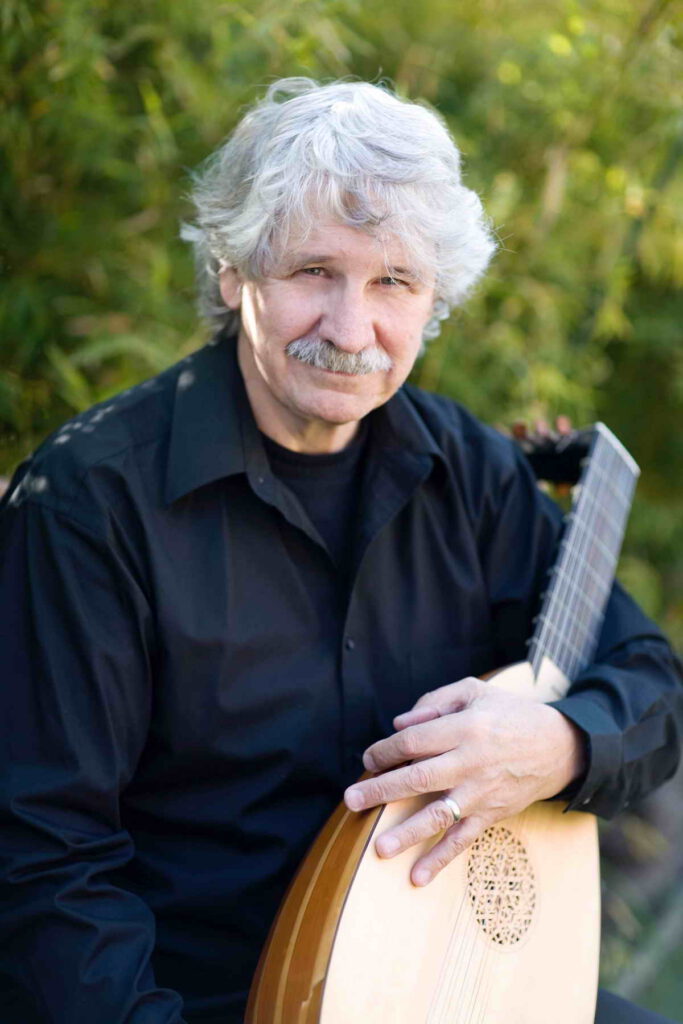
Sarge Gerbode's Lute Page

Here you will find more than 3000 lute pieces in French tablature in the following formats: Fronimo (ft2 and ft3), from Francesco Tribioli , TAB from Wayne Cripps, midi, and PDF (which you can read using Acrobat Reader). (Why the different formats?).  I apologize to those who prefer other formats, such as Spanish or Italian, but I believe French is the most widely-used format, and anyway, it’s easiest for me!  For those who have Fronimo, though, it is easy to change to another format – even German tab (not that anyone would really want to do this…)!

This material is now mirrored at lute.omerkatzir.com, thanks to the good offices of Omer Katzir and on www.lute.ru/gerbode, thanks to Igor Varfolomeev , who has also translated the site into Russian at  www.lute.ru/gerbode/ru.  I will try to keep these sites as updated as possible, but gerbode.net is likely to be the latest and greatest.  I feel more secure with the data in several different places.

I have collected these pieces over the years from the internet or have entabulated and/or arranged or realized them myself. I have edited all of them and formatted them to fit nicely on US letter size paper (8.5 x 11 in), though some are formatted for US legal size (8.5 x 14 in). I have not formatted any for A4, as life is too short. Again, if you have Fronimo, it is pretty easy to reformat these to taste.  I have tried to create performable copy in all cases. These pieces are mostly for renaissance lute, but quite a few are for baroque lute and archlute, and a very few for theorbo, cittern, bandora, guitar etc. Other pieces include songs and continuo pieces, listed by composer. Under Lute ensemble in the list of composers, you will find pieces for two or more lutes.

If anyone wants to contribute stuff to my site, I now have an ftp directory dedicated to lute.  Details here.


NEW:

Newest item:  the complete solo works of John Dowland are now in place, thanks to the enormous help I have received from Gian Luca Lastraioli, professor of lute at the Conservatorio di Musica di Trapani, who had already done most of the entabulations in 2005 and who kindly sent them to me.  I honestly did not expect to get such a rapid response to my request to have the missing ones filled in.  What is it they say:  “Ask, and it shall be given unto thee!”?  Of course, there are many variants of each piece.  I have provided only a representative sample, I hope most of the better versions.

I am still working on Fuenllana’s Orphenica Lyra.  I have completed Book 1 (consisting of 2- and 3-part pieces) and Book 2 (consisting of 4-part pieces).   Half of the pieces from Book 2 and some from Book 1 are vocal entabulations with a melody part in a different color in the tab and the text underneath.  I have put the words under the tab where the composer underlay them.  I managed to obtain a color facsimile of the original in the form of a CD from Los Angeles Classical Guitars’ website (which also contains several different vihuela books), so I can now identify the colored notes representing the melody line.  Fronimo does not allow for individual colored notes, so I have made a separate mensural vocal part for each piece, through Book 2 so far – a real challenge figuring out the note durations and the text underlay.  I actually painstakingly colored all the notes in the PDF version of piece #11, using Adobe Acrobat editor, but this would take too long to do other than as an example.  You can compare it with my mensural display of the same piece.  In any case, with or without the separate vocal part, the vocal entabulations are very clever, thoughtful, and beautiful, as are the fantasies that accompany them. More on Fuenllana’s notations.

I recently completed the complete lute songs of John Coprario, including “Funeral Teares”, “The Masque of Squires” and, earlier, “Songs of mourning”, to add to my collection of English lute songs.  Along the same line, I have entabulated and edited Thomas Ford’s “Music of Sundrie Kindes” (1607), which contains 11 lute songs which are also arranged for 4 vocal parts.  That was a major task, but an even more major one was entabulating and editing the second half of the book, consisting of 18 scordatura viol duets.  These are very lovely but contain many errors and inconsistencies in the tab, and sussing them out sometimes seemed like putting together a crossword puzzle where the pieces keep changing shape.  But when each puzzle was put together, the rewards were great.  I also did an arrangement of each one for two equal lutes, taking advantage of the fact that a lute can play non-adjacent strings.  In my opinion, these turn out to be among the best lute duets that I know of.

I also now have online the Capirola lute book in Italian and French tab and the da Crema Intabolatura di lauto.  In the Capirola directory, there is a comments file explaining the peculiarities of the Capirola MS.  Also new are some Marchetto Cara songs, realizations of three- and four-part frottole from around 1510.  Quite lovely and also fairly easy. Also the Beatles’ “If I fell in love with you”, which I arranged for a wedding.  I have also added to my site a complete edition of Alonso Mudarra’s three-volume work, “Tres libros de música en cifra para vihuela” (1546), including 50 solo pieces and 27 vocal ones.  All very high quality stuff!

I have also completed an edition of the five very charming songs from Campion’s “A description of a masque” (1607).

I have entabulated Bakfark’s Intabulatura, Liber Primus (1552), with four fantasies and 16 vocal entabulations and the Cracow Lute Book (1565), with three fantasies and 9 vocal entabulations.  These are pieces that could best be described as a “handful”, being 4, 5, and 6-part entabulations.  But an amazing tour de force if one can accomplish them, as Jacob Heringman has done awhile back.  I have also entabulated several other pieces by Bakfark, including three other fantasies.

File-Naming Conventions

My file-naming conventions are not entirely self-consistent, but mostly the following tags show the content of a given file:

O = ornamented version (sometimes might mean "original").
S = score -- i.e., all parts.
T = L = tablature
V = voice or violin -- in any case, the top part.
B = Bass line

P, P1, P2, etc. = performance versions with additional notations, different fingerings, that I have used in a particular performance.

3, 4, 5, etc. = 3, 4, 5 etc. part mensural scores.

These can be combined in various ways.  OVB, for instance, would mean ornamented version of the top line and bass.

Sometimes A, Bb, C, D, E, F, G, etc., refer to versions of the piece in these keys, usually transposed from the original.

HELP!

I have, sitting on my computer, 3 books of tablature by Giacomo Gorzanis, and Part 2 (“der ander Theil”) of  Hans Hewsidler 1536 book more or less ready to go, but I am holding off for awhile in the hope that whoever entabulated this marvelous stuff will tell me who he is so I can give him credit.  Does anyone know?.  Judging from the style of the entabulations, I am guessing the same person did both.

I have recently posted on my site Suite 18 of J.J. Froberger, for baroque lute.  This has been sitting on my computer for some time, and I know neither the source nor the entabulator of the piece, but it is beautiful, so I thought I would share it with you.  If anyone can fill in the missing information, please let me know!

To Err is Human; to Correct, Divine

Although I have tried to be as accurate as possible, I'm sure many errors remain. I have cited the original source (MS or otherwise) whenever I knew it, and the original contributor/entabulator, though over the years much of this data has been lost. If you feel you are the one that originally contributed a particular piece and have not been acknowledged in a footnote for having done so, or if you know the source of a particular piece for which a source is not cited or wrongly cited, please email so I can update the footnote. Also, if you find errors in any of the pieces, can you please email me and, if possible, attach the modified version?

Correction acknowledgments.  Thanks to:

·        Ron Andrico, for pointing out that “O Mistress Mine” is not originally by Byrd or Morley, but anonymous and arranged by each of them.

·        Éric Bellocq, for noticing that I put Händel Trio Sonata in F under “Bach” as well as Händel.

·        Simone Colavecchi for corrections to Zamboni Sonata IX.

·        Miles Dempster for his correction on Hewet’s Fantasy from “Varietie of Lute Lessons”.

·        Craig Fruetel for a correction to a Dalza piva.

·        Luis Gásser, for help on Fuenllana notations and for translating some key passages in Orphenica Lyra.

·        Vladimir Kaminik, for a correction to Book 1, #1, Pleni, from Missa Hercules of Josquin.

·        Ed La Pointe, for corrections to Saltarello 48 of da Crema.

·        Gian Luca Lastraioli, for filling in the missing Dowland solo pieces.

·        David Lenson, for corrections to Dowland’s La mia Barbara.

·        Rob MacKillop, for helping with Fuenllana notations.

·        Ed Myers for correction of a mislabeling of Dowland solo #38: “Viscount Lisle’s Galliard” as #37: “Lord Chamberlain’s Galliard”.  Also for corrections to Dowland’s “Come heavy sleep”.

·        Patrick Setzer for a correction to Campion’s “The man of life upright”.

·        Benjamin Stehr, for a correction and addition to Capirola’s Ricercar 1.

·        Michael Wilhite for corrections to Dowland “If my complaints” and “Rest awhile, you cruel cares”.

·        Wolfgang Wiehe for corrections to my edition of Bakfark’s “Ultimi mei sospiri”, in Bakfark’s 1552 “Intabulatura”.


Many thanks to all of you!

******************************

I hope you get and give a great deal of pleasure from playing these pieces!

Sarge Gerbode

You can email me at: sarge@gerbode.net with any comments, corrections, or special requests.